Which ASHRAE audit level is right for my building or project?
The right audit level depends on what decision the audit needs to support. A Level 1 walk-through is appropriate as a first step for a building owner who wants a quick, low-cost initial indication of whether further investigation is worthwhile — it identifies obvious opportunities but provides only rough savings estimates (±25–50% accuracy), not enough to commit significant capital. A Level 2 detailed survey is the most commonly commissioned audit type — appropriate for a building owner building a business case for retrofit investment, requiring savings estimates accurate enough (±20%) to prioritise measures and seek internal budget approval, but not necessarily bankable for external financing. A Level 3 investment-grade audit is required when the savings projections need to be bankable — for ESCO performance contracts where the contractor guarantees savings, for green financing or sustainability-linked loans where lenders require verified projections, or for major capital programmes where the financial risk of inaccurate projections is significant. Virtual Bridge recommends the appropriate level based on the client's decision-making context during the initial scoping conversation.
How much can a typical energy audit be expected to identify in savings?
In Virtual Bridge's GCC and Africa project experience, a typical commercial building energy audit identifies total potential savings of 15–35% of current energy consumption across the full range of measures (operational, low-cost retrofit, and capital retrofit combined). This range varies significantly based on the building's age, the sophistication of its existing controls, and how recently it has had energy efficiency work done. A building that has never had a BMS optimisation or controls review will typically have the largest savings opportunity in the low-cost/no-cost category — often 5–15% of consumption achievable through control sequence corrections and operational schedule adjustments alone, at near-zero capital cost. A building with already well-optimised controls will have a smaller low-cost opportunity but may still have significant capital retrofit opportunity (equipment upgrades, lighting retrofit, renewable energy) depending on the age of the installed equipment. Virtual Bridge does not provide a generic savings percentage before conducting the audit — the actual figure is determined from the building's specific data and condition.
Does Virtual Bridge have to implement the recommended measures, or can the client use another contractor?
There is no obligation for the client to use Virtual Bridge or A&S Mechanical for implementation. The audit deliverable is a technically complete roadmap that any qualified contractor could implement — with sufficient engineering detail (equipment specifications, control sequence requirements, financial justification) that the client can put it out to competitive tender if they choose. This is intentional: Virtual Bridge's consulting service is structured to provide genuinely independent analysis, not a sales tool for the contracting business. That said, many clients do choose to proceed with Virtual Bridge or A&S Mechanical for implementation, because the audit team's deep knowledge of the specific building (developed during the survey and analysis) provides continuity value, and because A&S Mechanical's HVAC, electrical, and renewable energy capabilities mean most recommended measures can be delivered under one contracting team without re-tendering or re-scoping.
What is IPMVP and why does it matter for measurement and verification?
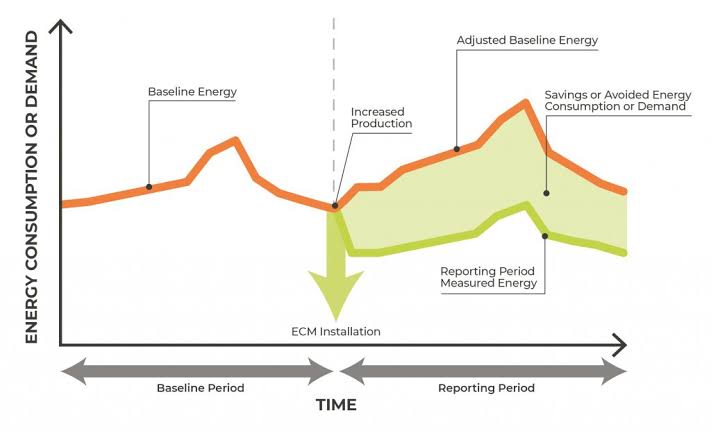
The International Performance Measurement and Verification Protocol (IPMVP) is the globally recognised standard methodology for quantifying the actual energy savings achieved from an efficiency project — comparing metered post-implementation energy consumption against a normalised baseline that accounts for changes in weather, occupancy, and operating conditions between the baseline period and the reporting period. IPMVP defines four measurement options (A through D) with different levels of rigour and cost, applied depending on the measure type and the materiality of the savings being verified. M&V matters because a projected savings figure from an audit is an estimate — the only way to know whether the savings were actually achieved is to measure them after implementation using a defensible, internationally recognised methodology. This is particularly important for ESCO (Energy Service Company) performance contracts, where the contractor's payment is tied to verified savings, and for green financing or sustainability-linked loans, where lenders and investors require independently verifiable data rather than contractor claims. Virtual Bridge provides IPMVP-compliant M&V services for clients implementing efficiency measures, whether or not Virtual Bridge performed the implementation.
Can an energy audit support a LEED or Estidama green building certification?
Yes. Energy performance is one of the largest credit categories in both LEED (Energy and Atmosphere) and Estidama (Energy Pearl credits), and a calibrated building energy model — the type of analysis produced in a Level 2 or Level 3 audit — is exactly the documentation required for these submissions. For LEED, Virtual Bridge's energy modelling demonstrates the building's performance against the ASHRAE 90.1 baseline, supporting the Optimize Energy Performance credit, and Virtual Bridge's renewable energy yield analysis supports the Renewable Energy Production credit where solar PV is installed. For Estidama, the calibrated model and renewable energy assessment support the relevant Energy Pearl credit requirements for Abu Dhabi developments. Virtual Bridge structures the audit deliverable to be directly usable as green building submission documentation — avoiding the need for a separate energy modelling exercise specifically for certification purposes.
How long does an energy audit take and what does the client need to provide?
Timeline depends on the audit level and building size. A Level 1 walk-through audit for a single building typically takes 1–2 weeks from site visit to report delivery. A Level 2 detailed audit, including temporary sub-metering for 2–4 weeks to capture a representative period of building operation, typically takes 6–10 weeks total. A Level 3 investment-grade audit, including detailed engineering design and contractor cost quotations, typically takes 10–16 weeks. The client needs to provide 12 months of utility billing data (electricity, water, and gas where applicable), building drawings (architectural and MEP if available), equipment schedules or nameplate data where available, and site access for the survey team and for temporary sub-metering equipment installation. Virtual Bridge provides a detailed information request at the start of the engagement to ensure the right data is collected efficiently.