Should I specify Cat 6 or Cat 6A for a new building?
Virtual Bridge specifies Cat 6A as the default for all new commercial, institutional, and residential buildings. Cat 6A supports 10 Gbps to the full 100-metre channel distance, whereas Cat 6 only reliably supports 10 Gbps to approximately 37 metres in typical building installations — meaning a significant portion of Cat 6 links in a real building will not perform to 10 Gbps. Cat 6A also supports IEEE 802.3bt PoE++ (up to 90W per port), which is increasingly required for higher-power devices including Wi-Fi 6 access points, PTZ cameras, and intelligent IoT devices. The incremental cost of Cat 6A over Cat 6 is approximately 15–20% of cabling material cost — a small premium against the total project cost for infrastructure that is designed to last 20+ years and support technology that does not yet exist. Replacing Cat 6 with Cat 6A after occupation is extremely disruptive and expensive.
What does TIA-568 certification mean and why does it matter?
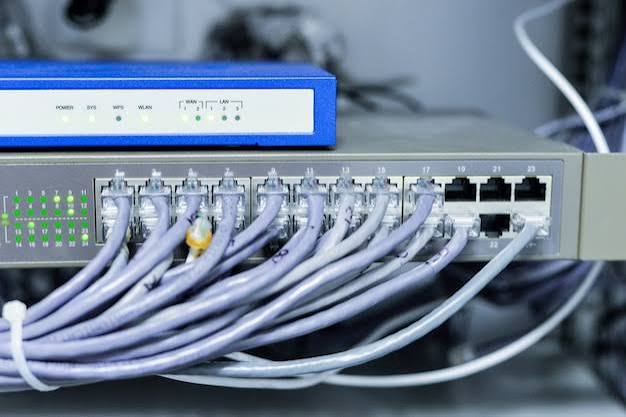
TIA-568 (Telecommunications Infrastructure Standard for Commercial Buildings) is the primary North American standard for structured cabling systems — defining the performance requirements for copper and fibre cabling components and the channel (end-to-end) performance that an installed cabling system must achieve. ISO 11801 is the equivalent international standard. Certification means that every installed copper link has been tested with a calibrated channel tester (Fluke DSX-8000 or equivalent) against all required parameters — insertion loss, return loss, near-end crosstalk (NEXT), far-end crosstalk (ELFEXT), and more — and every link has either passed or been remediated until it passes. A certified cabling installation is one where you have documentary evidence that every link will perform to the specified standard. Without certification, you have an installed assumption — which is not the same thing. TIA certification is also required to activate most cabling manufacturer channel warranties, which provide product replacement and application support for 15 to 25 years.
How does Virtual Bridge handle VLAN design for buildings with multiple technology systems?
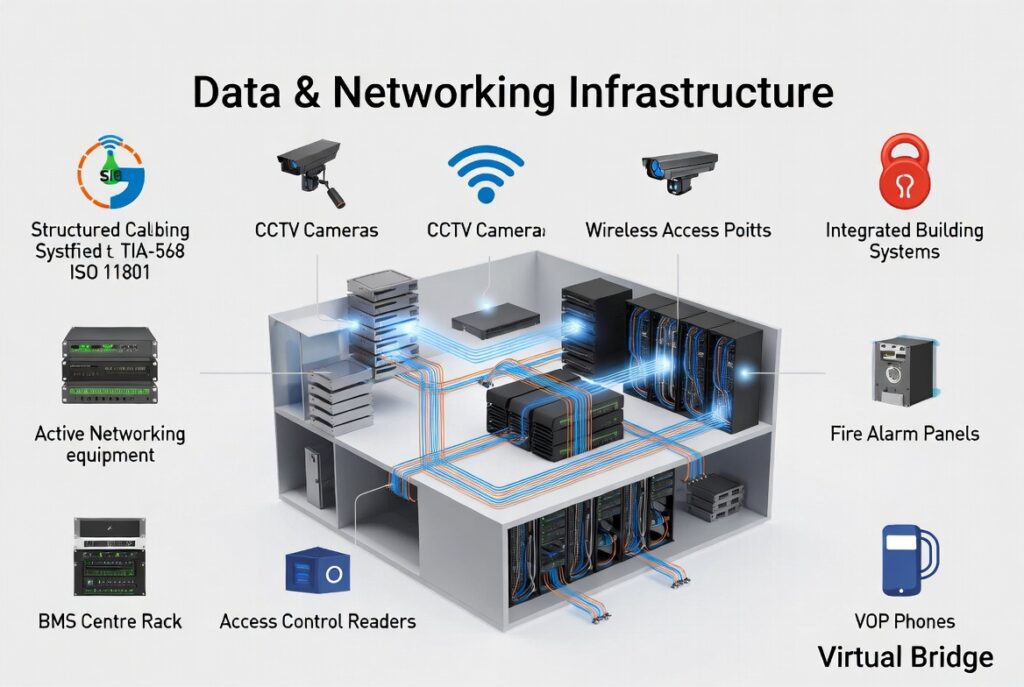
VLAN (Virtual Local Area Network) segmentation is essential in buildings where multiple technology systems share the same physical network infrastructure — CCTV cameras, access control controllers, BMS devices, IP phones, wireless access points, and user workstations cannot all be on the same network without creating security risks and performance problems. Virtual Bridge designs a VLAN architecture appropriate to the building's systems before the active equipment is configured. Typical VLAN segregation includes a dedicated VLAN for each major system: CCTV (isolated from other systems, preventing camera video from competing with business data), access control (security-sensitive, requiring isolation from general user networks), BMS (operational technology network, isolated from IT networks), VoIP (requiring QoS prioritisation for voice quality), wireless (with separate SSIDs for staff and guest, each on its own VLAN), and the corporate data network. Virtual Bridge coordinates this VLAN design with the system integrators for each building technology to ensure correct network addressing and inter-VLAN routing where required.
What is PoE and how much PoE power does a modern building network need?
Power over Ethernet (PoE) allows network switches to deliver electrical power to connected devices over the data cable — eliminating the need for a separate power outlet at each device location. PoE is essential for IP cameras, wireless access points, IP phones, access control readers, and an increasing range of IoT and BMS devices. The PoE standards have evolved significantly: original PoE (802.3af) delivers up to 15.4W per port; PoE+ (802.3at) delivers up to 30W; and PoE++ (802.3bt) delivers up to 60W (Type 3) or 90W (Type 4) per port. Modern Wi-Fi 6 access points require 25W (PoE+) or more. High-resolution PTZ cameras with heaters in outdoor environments may require 60W (PoE++ Type 3). For a building with 50 IP cameras, 30 wireless access points, and 200 IP phones, the total PoE power requirement can easily exceed 5,000W. Virtual Bridge calculates the PoE power budget for every network switch as part of the network design — ensuring the selected switches have sufficient PoE power capacity for all connected devices, including growth allowance.
Does Virtual Bridge provide network maintenance after handover?
Yes. Virtual Bridge provides ongoing support for installed data networking infrastructure — including cabling fault investigation and repair, active equipment health check and firmware update review, wireless network optimisation (access point placement adjustment, channel plan review as the RF environment changes), switch configuration changes, VLAN additions for new building systems, and network documentation updates as the installation grows. For active networking equipment under ongoing management, Virtual Bridge can provide network monitoring (SNMP trap monitoring, bandwidth utilisation reports, device health dashboards) and first-line support for network faults. This support is available across all Virtual Bridge operating territories, with response times agreed at the time of handover.
What is Virtual Bridge's relationship with SITA and how does it apply to airport projects?
Virtual Bridge (via its JFC group company) is a SITA preferred subcontractor — a designation that recognises Virtual Bridge's capability to deliver SITA-compliant airport IT and technology infrastructure including structured cabling, active networking, CUTE (Common Use Terminal Equipment) terminal networks, DCS (Departure Control Systems) network infrastructure, FIDS (Flight Information Display Systems) cabling, airport CCTV and security networks, and passenger Wi-Fi. SITA is the global IT provider for the air transport industry, and SITA-preferred subcontractor status is an important commercial credential for airport IT infrastructure projects across Africa and the Middle East. Virtual Bridge has delivered SITA-compliant airport network infrastructure at Luanda, Namibe, and Catumbela airports in Angola, and at Ambouli International Airport in Djibouti. For airport clients requiring SITA-standard IT infrastructure delivery, Virtual Bridge's track record and preferred partner status provides confidence in the team's capability to meet the specific requirements of aviation IT environments.