virtual bridge

VirtualBridge - Navigation Header

Solar PV Systems

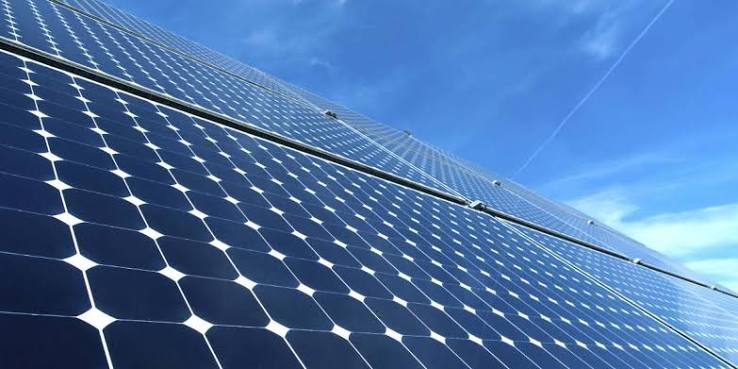
Virtual Bridge designs, supplies, installs, commissions, and maintains complete solar photovoltaic systems across the GCC and Africa — from rooftop residential systems and commercial rooftop arrays to ground-mount utility-scale installations, carport solar canopies, and Building-Integrated Photovoltaics (BIPV). Delivered by A&S Mechanical & Renewable Energy, a Virtual Bridge Group company with 25+ years of regional mechanical and renewable energy expertise, every solar PV system is engineered from first-principles yield analysis, sized to the actual load profile and available roof or land area, and co-delivered alongside the building’s HVAC, electrical, and plumbing scope for seamless grid integration and maximum energy offset.


Renewable Energy — A&S Mechanical & Renewable Energy / Virtual Bridge Co.

GCC Solar Irradiance
2,400+
kWh/m²/year — among the highest on earth
Typical Energy Offset
30–70%
Of building electricity demand — depending on available area
Group Expertise
25+
Years via A&S Mechanical & Renewable Energy
System Range
3kWp+
Residential to utility scale — any size, any roof type
Solar PV Systems

Every system type. Every mounting configuration. Every scale.

Virtual Bridge delivers the full spectrum of solar PV technology — from a 5 kWp residential rooftop to a multi-MW ground-mount, each engineered from first-principles yield analysis with the actual GCC solar resource data for the project location.

Residential Rooftop PV
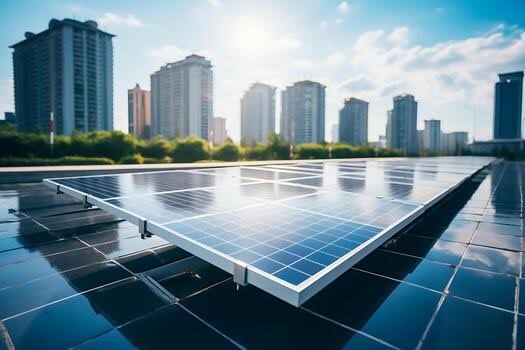
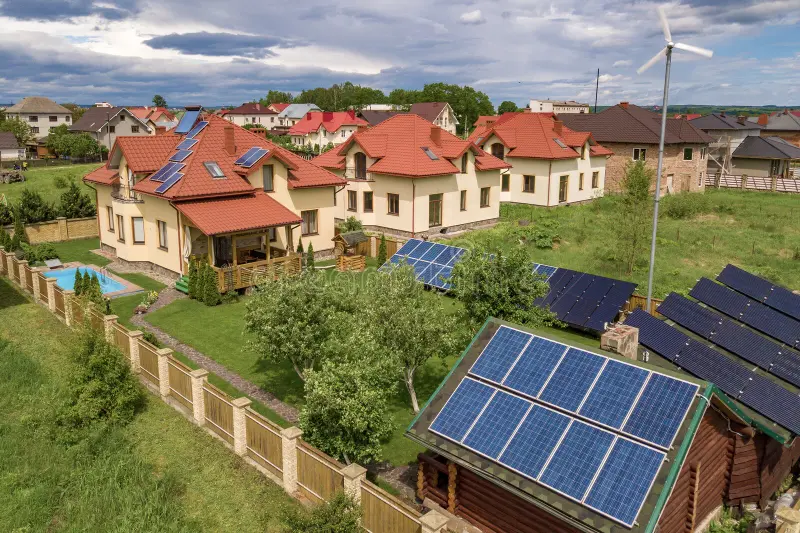
Grid-tied and hybrid rooftop solar PV for villas and residential buildings — 3 kWp to 100 kWp systems using monocrystalline panels on flat or pitched roofs. String inverters and micro-inverters, BESS integration for evening self-consumption, export limiting for grid compliance, and smart monitoring via app. Sized to the household's actual electricity tariff profile and consumption data.
Grid-TiedHybrid+BESS3–100 kWpApp Monitoring
Commercial Rooftop PV
Rooftop solar for commercial and industrial buildings — 100 kWp to 1 MWp installations on flat concrete roofs using ballasted or mechanically fixed mounting systems. Central and string inverter configurations, transformer-coupled grid connection, energy metering integration with BMS, and net metering or feed-in tariff setup for utility billing. Structural loading assessment included in design scope.
100 kWp–1 MWpFlat RoofBMS MeteringNet Metering
Ground-Mount & Carport Solar
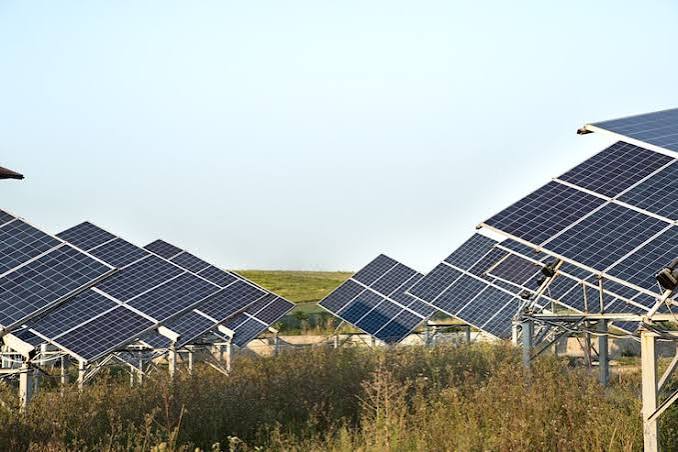
Ground-mounted solar arrays on fixed-tilt or single-axis tracker structures for industrial sites, campuses, and land-based installations. Solar carport canopies providing shaded parking while generating electricity — increasingly popular in GCC commercial and retail developments. Civil design for foundations, cable routes, and security fencing included in project scope.
Fixed TiltTrackerCarportCivil Included
Battery Energy Storage (BESS)
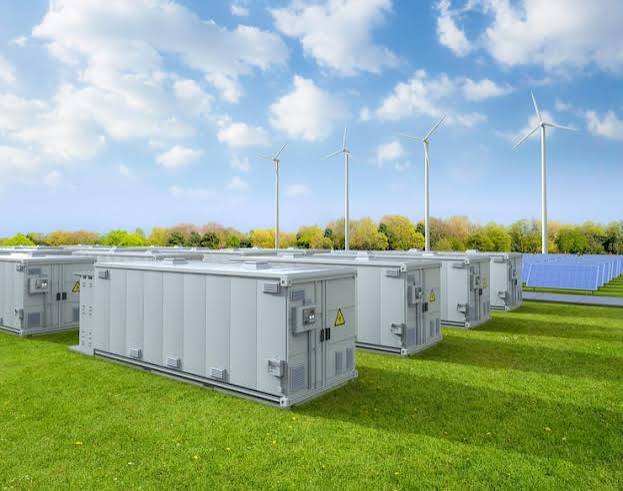
Lithium-ion battery energy storage systems integrated with solar PV — storing excess daytime generation for use at night, providing backup power during grid outages, enabling peak demand shaving to reduce demand charges, and optimising self-consumption to maximise return on solar investment. Scalable rack-mounted and containerised BESS from 5 kWh to multi-MWh capacity.
Lithium-IonPeak ShavingBackup PowerSelf-Consumption
Building-Integrated PV (BIPV)
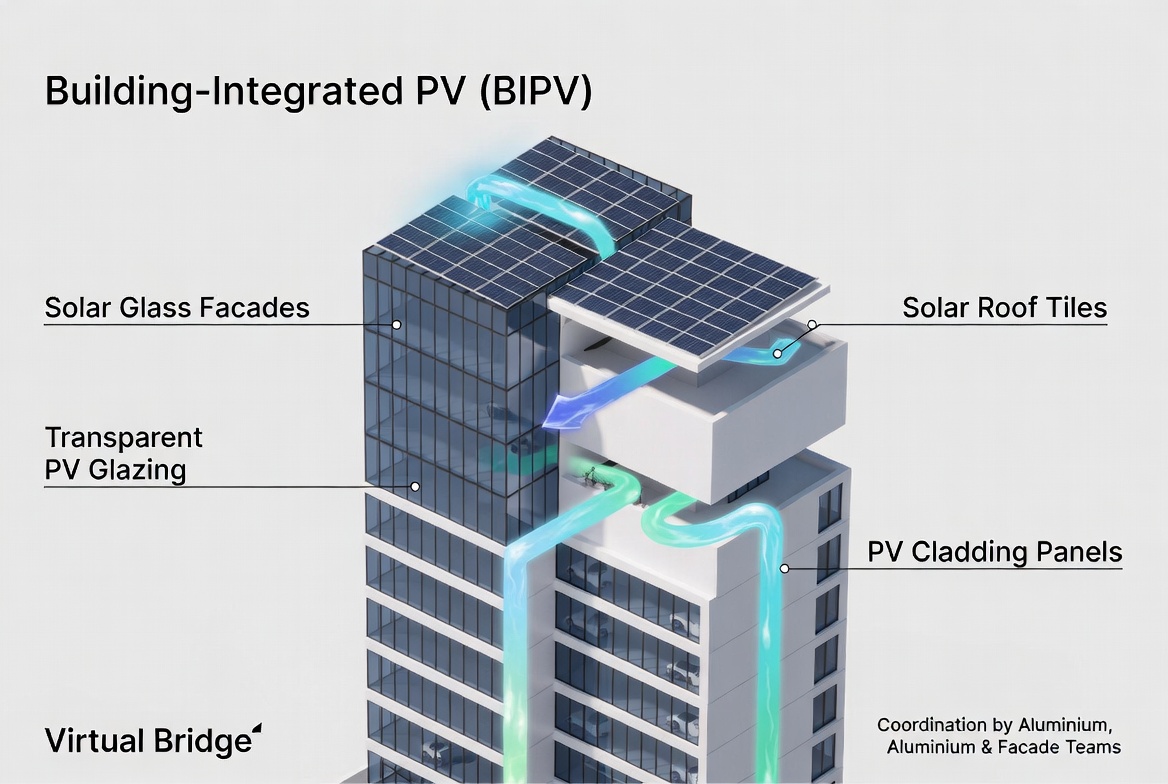
Solar panels integrated into the building fabric — solar glass facades, transparent PV glazing, solar roof tiles, and PV cladding panels that replace conventional building materials while generating electricity. Relevant for premium commercial and government buildings where aesthetics are a priority and conventional rooftop mounting is not appropriate. Coordinated with Virtual Bridge's aluminium and facade contracting teams.
Solar FacadeBIPVTransparent PVSolar Tiles
Solar Monitoring & O&M
Real-time solar system monitoring — generation data, self-consumption ratio, grid import/export, battery state of charge, inverter performance, and string-level fault detection. Remote monitoring portal and mobile app for facility teams. Planned preventive maintenance contracts covering panel cleaning (critical in Gulf dust environments), inverter servicing, electrical connection inspection, and annual performance review against the yield model.
Real-TimeString MonitoringPanel CleaningAnnual Review
A&S Mechanical's Renewable Energy Capability Makes Virtual Bridge Unique Among GCC MEP Contractors
Most MEP contractors in the GCC deliver HVAC, plumbing, and firefighting — and subcontract solar PV to a separate renewable energy company. Virtual Bridge's group company A&S Mechanical & Renewable Energy delivers both the conventional MEP systems and the solar PV and BESS — allowing solar generation to be directly sized against HVAC energy demand (the dominant load in GCC buildings), and the electrical interfaces to be designed, installed, and commissioned under one integrated contracting team.
Gulf Solar Resource

The GCC Has Some of the Highest Solar Irradiance on Earth. Every Building Should Use It.

Saudi Arabia, the UAE, Kuwait, and Qatar sit in the global solar belt — receiving annual solar irradiance between 2,000 and 2,400+ kWh/m²/year, making them among the most productive locations on the planet for solar PV generation. This is not a marginal renewable energy opportunity. It is a compelling, project-by-project financial case.

2,400 kWh/m²/year — Saudi Arabia Peak Irradiance
Riyadh and the central Arabian Peninsula receive some of the highest Global Horizontal Irradiance (GHI) values globally — consistently exceeding 2,300 kWh/m²/year in most locations. Dubai and Abu Dhabi reach 2,000–2,100 kWh/m²/year. In practical terms, a 1 kWp solar system in Riyadh produces approximately 1,700–1,900 kWh per year — compared to 900–1,100 kWh in northern Europe. The financial return on solar investment in the GCC is therefore significantly faster than in most other regions of the world.
Riyadh GHI
2,350
kWh/m²/year — among the highest globally
Dubai GHI
2,080
kWh/m²/year — coastal irradiance, year-round generation
Yield / kWp
1,800
kWh/year — typical Riyadh rooftop system specific yield

Regulatory & Policy Context

Saudi Vision 2030 — 50% Renewables Target
Saudi Arabia's National Renewable Energy Program targets 50% of electricity from renewables by 2030 — driving demand for commercial and industrial solar PV across government, real estate, and private sector projects.
UAE Net-Zero 2050 & Estidama
UAE Net Zero by 2050 strategy and Estidama Pearl Rating system both reward on-site renewable energy generation — solar PV is a key contributor to Pearl credits for energy and water efficiency in Abu Dhabi.
DEWA Net Metering — Dubai
DEWA's Shams Dubai net metering programme allows solar PV system owners to export surplus generation to the grid and receive bill credits — improving project economics for commercial rooftop solar in Dubai.
SEC Self-Generation — Saudi Arabia
Saudi Electricity Company (SEC) regulations permit commercial and industrial self-generation from solar PV — with net metering and wheeling arrangements for qualifying projects above minimum capacity thresholds.
LEED Energy & Atmosphere Credits
On-site renewable energy generation contributes directly to LEED Energy and Atmosphere credits — Virtual Bridge provides the generation data and system documentation required for LEED certification submissions.
Africa — Off-Grid & Hybrid Opportunity
Across African project territories, where grid reliability is low and diesel generation costs are high, solar PV plus BESS hybrid systems provide reliable, low-cost power and a compelling return on investment versus continued diesel dependence.
How We Deliver

Yield model to energised array — one team.

Virtual Bridge manages the complete solar PV project lifecycle — from site assessment, shading analysis, and PVsyst yield modelling through structural loading assessment, equipment procurement, mechanical and electrical installation, grid connection, commissioning, performance verification, and ongoing O&M. Every system is designed to the actual solar resource of the project location, the actual roof or ground area available, and the actual electricity tariff and consumption profile of the building — not to generic calculator estimates.

Solar PV works are coordinated directly with Virtual Bridge's electrical team (grid connection, metering, LV board modifications), HVAC team (solar generation offset against air conditioning load), and BMS team (solar generation and self-consumption data into the building energy dashboard) — under the A&S Mechanical renewable energy and Virtual Bridge integrated delivery model.

PVsyst Yield Modelling — Not Back-of-Envelope Estimates
Every Virtual Bridge solar PV system is modelled in PVsyst (the industry-standard simulation software) using TMY (Typical Meteorological Year) irradiance data for the specific project location, actual roof orientation and tilt angle, shading analysis from a 3D model of the building and surroundings, panel degradation curve, and inverter efficiency model. The output is a month-by-month predicted yield in kWh/year, self-consumption ratio, and financial return — not a generic rule-of-thumb estimate. This PVsyst report is provided to the client as part of the feasibility study and referenced at commissioning to verify actual system performance against prediction.
01
Site Assessment & Feasibility
Roof or land survey, shading analysis, structural loading assessment, grid connection point identification, utility tariff review, and consumption data analysis — establishing available area, system size range, expected yield, financial return, and payback period.
02
PVsyst Yield Modelling & System Design
PVsyst simulation using TMY irradiance data and 3D shading model. Panel layout optimisation, inverter selection, string configuration design, BESS sizing (if applicable), and single-line electrical diagram — submitted for utility and authority review.
03
Utility Application & Authority Approval
Grid connection application to the relevant utility (DEWA, SEC, ADDC, MEW), net metering or self-generation permit, and any municipality or authority submission required — managed by Virtual Bridge in every territory of operation.
04
Mechanical & Electrical Installation
Panel and mounting structure installation, DC cabling, inverter installation, AC connection to the main distribution board, generation meter installation, protection relay configuration, and BMS/monitoring interface installation — by Virtual Bridge's installation team.
05
Commissioning, Grid Energisation & Handover
System functional test, inverter commissioning, grid protection relay test, string IV curve measurement, monitoring platform configuration, utility grid energisation, O&M manual, and first-year performance report — compared against the PVsyst yield prediction at handover.
Technical Capabilities

Equipment, system types, and integration scope.

A reference of Virtual Bridge's solar PV technical scope — covering panel technologies, inverter types, BESS configurations, mounting systems, and integration capabilities.

System Scale
3 kWp+
Residential to utility-scale multi-MW
Panel Efficiency
22%+
Monocrystalline PERC and TOPCon — highest efficiency
BESS Chemistry
LFP
Lithium iron phosphate — safest, longest-life chemistry
Simulation Tool
PVsyst
Industry standard — TMY data, 3D shading, yield report

Solar PV Technology

Monocrystalline PERC Panels
The industry standard — Passivated Emitter and Rear Cell technology delivering 20–22% efficiency. Best performance in the diffuse light conditions of Gulf summer haze and dust.
TOPCon & HJT High-Efficiency Panels
Tunnel Oxide Passivated Contact (TOPCon) and Heterojunction (HJT) panels delivering 22–24% efficiency — specified where roof area is limited and maximum generation per square metre is the priority.
Bifacial Panels
Bifacial panels capturing reflected irradiance from the ground or roof surface — delivering 5–15% additional generation versus monofacial panels at elevated or tilted mounting heights.
String Inverters
For residential and small commercial systems — cost-effective, widely serviceable, and well-suited to simple roof geometries with minimal shading. SMA, Sungrow, Huawei, and Fronius platforms.
Central Inverters
For large commercial and utility-scale installations — single high-power inverter for simple array geometries, lower cost per kW, and straightforward maintenance access.
Micro-Inverters
Panel-level power conversion — for complex roof geometries with multiple orientations or partial shading, eliminating the string mismatch losses that reduce system yield on shaded arrays.

BESS, Mounting & Integration

LFP Battery Energy Storage
Lithium Iron Phosphate (LFP) chemistry — the safest lithium battery technology, with the longest cycle life (3,000–6,000 cycles), lowest degradation rate, and best thermal stability for GCC ambient temperatures.
Hybrid Inverter Systems
Combined solar PV inverter and battery charger/inverter in one unit — for residential and small commercial systems where simplicity and cost efficiency are the priority alongside BESS integration.
Ballasted Flat Roof Mounting
Concrete ballast weighted mounting systems for flat concrete roofs — no roof penetrations required, preserving waterproofing integrity, with tilt angle optimised for the project latitude.
Mechanically Fixed Mounting
Roof-penetrating fixed mounting for membrane and metal deck roofs — engineered to the roof structure, with waterproof roof penetration details reviewed by the structural engineer.
BMS & Energy Dashboard Integration
Solar generation, self-consumption, grid import/export, and BESS state of charge integrated into the building BMS energy dashboard — unified energy visibility across all building systems.
EV Charging Integration
Solar PV generation used to power EV charging stations — solar-to-EV energy routing, smart charging control to prioritise solar generation, and EV charging load included in the solar system sizing.
Sectors We Serve

Every building type. Every solar opportunity.

Virtual Bridge has delivered solar PV systems across every major building sector — each with its own load profile, roof or land area, utility tariff, and regulatory framework.

Residential Villas & Apartments
Rooftop solar with BESS for villas — offsetting air conditioning loads during peak hours, reducing electricity bills, and providing backup power during outages in regions with grid instability.
Commercial Office
Commercial rooftop solar offsetting daytime electricity demand — aligned with office occupancy patterns for maximum self-consumption. Integration with BMS for energy management and LEED reporting.
Hospitality
Hotel rooftop solar reducing energy operating costs — often combined with solar thermal for domestic hot water pre-heating. Estidama and LEED credit contribution for green building submissions.
Industrial & Logistics
Large flat-roof industrial solar — maximising generation from extensive roof areas, with BESS for peak demand shaving, EV charging for logistics fleet, and carport solar for vehicle parking areas.
Government & Civic
Government building solar aligned with national renewable energy targets — Vision 2030 energy compliance documentation, public sector energy reduction programmes, and government campus ground-mount arrays.
Education
School and university campus solar — large roof areas with daytime-aligned occupancy patterns for high self-consumption, curriculum integration opportunities, and institution sustainability reporting.
Retail & Shopping Malls
Mall rooftop and carport solar — large available areas, daytime-aligned retail occupancy for high self-consumption, and carport canopies providing shaded parking alongside solar generation.
Africa — Off-Grid & Hybrid
Solar + BESS hybrid systems for African project territories where grid reliability is low — displacing expensive diesel generation, reducing operational cost, and providing reliable power for port, airport, and infrastructure operations.
Selected Projects

Solar PV systems generating. Verified against yield prediction.

A selection of Virtual Bridge solar PV projects across the GCC and Africa.

Residential — Lebanon
ADMA 751
Adma, Lebanon · 8,000 sqm · 2024
Rooftop Solar PV · BESS · Solar Thermal · Grid-Tied
Residential — Lebanon
Ô Bakish Villas
Bakish, Lebanon · 2026
Villa Solar PV · Hybrid BESS · EV Charging
Commercial — Saudi Arabia
Carlton Almoaibed Hotel Complex
Dammam, Saudi Arabia
Hotel Rooftop Solar · Energy Offset · BMS Integration
Infrastructure — Africa
Banana Seaport
Democratic Republic of Congo
Solar + BESS Hybrid · Diesel Displacement · Off-Grid
Airport — Angola
Namibe, Catumbela & Luanda Airports
Angola
Airport Solar PV · BESS Backup · Hybrid Grid
Commercial — GCC
Multi-Site Commercial Portfolio
Saudi Arabia & UAE
Rooftop PV · Net Metering · Vision 2030 Compliance
Why Virtual Bridge

Solar engineered from first principles. Integrated with the building it serves.

Virtual Bridge and A&S Mechanical deliver solar PV as part of an integrated building energy strategy — not as a standalone rooftop installation. The solar system is sized against the actual building load, co-designed with the HVAC and electrical teams, and monitored through the building BMS — delivering verified energy savings, not just a panel count.

PVsyst First-Principles Design
Every system modelled in PVsyst with TMY irradiance data and 3D shading analysis for the specific location — not sized by rule of thumb. Yield prediction and financial return documented before any equipment is ordered.
Integrated MEP Delivery
Solar sized against HVAC energy demand and co-delivered with electrical, HVAC, and BMS works under one group — ensuring the solar generation, grid connection, and energy metering are designed and installed as one integrated system.
Utility & Authority Approval Managed
Grid connection application, net metering permit, and any municipality submission managed by Virtual Bridge — across DEWA, SEC, ADDC, KAHRAMAA, and African territory utility authorities.
Sustainability Documentation
PVsyst yield report, generation metering data, self-consumption ratio, and carbon offset calculations provided for Vision 2030, Estidama, LEED, and green building certification submissions.
Common Questions

Frequently Asked Questions

The available solar capacity depends on the usable roof area — accounting for setbacks, equipment, and shading from rooftop plant. A rule of thumb is approximately 5–7 kWp per 40 m² of usable roof area using standard monocrystalline panels. A 2,000 m² flat roof in Riyadh with 60% usable area (1,200 m²) could accommodate approximately 150–200 kWp of solar PV. At Riyadh's specific yield of approximately 1,800 kWh/kWp/year, this would generate 270,000–360,000 kWh per year. For a building consuming 800,000 kWh/year, this represents a 34–45% energy offset — a significant reduction in electricity bills that typically provides a simple payback of 5–8 years in Saudi Arabia at current commercial tariff rates. Virtual Bridge performs this analysis for every project using actual consumption data and the building's specific roof geometry.
A grid-tied system connects directly to the utility grid — solar generation is used to offset grid electricity consumption, and surplus is exported (where net metering is available). When the grid is unavailable, a grid-tied system shuts down for safety reasons. This is the most common commercial system type in GCC cities with reliable grid supply. An off-grid system has no grid connection — all power is supplied by solar plus battery storage, with a generator backup for extended low-irradiance periods. Off-grid systems are specified in locations without grid access and in African project territories with unreliable or non-existent grid supply. A hybrid system has both a grid connection and battery storage — operating as grid-tied when the grid is available, charging the battery from solar surplus, and providing backup power from the battery if the grid fails. Hybrid systems are the preferred choice for critical facilities (hospitals, data centres, hotels) and for buildings where both self-consumption maximisation and grid backup are required.
Two Gulf-specific factors affect solar PV performance: high temperatures and dust soiling. Solar panels lose approximately 0.3–0.5% of output per degree Celsius above their standard test condition temperature (25°C). In Gulf summer conditions, panel temperatures can reach 65–75°C, causing 12–25% power reduction versus the nameplate rating. This is accounted for in the PVsyst yield model — which uses actual temperature data to predict real-world generation rather than the standard test condition rating. Dust soiling is the second significant factor — sand and dust accumulation on panels can reduce generation by 10–25% between cleaning cycles in dusty Gulf environments. Virtual Bridge specifies panel cleaning intervals as part of the O&M plan and uses soiling loss data from the specific location in the PVsyst model. Panels with hydrophobic anti-soiling coatings are available and specified for sites with high dust exposure. The combination of high irradiance and manageable soiling means GCC solar systems still outperform most global locations even accounting for these factors.
Net metering allows solar PV system owners to export surplus generation to the grid and receive bill credits at an agreed tariff — effectively using the grid as a virtual battery when solar generation exceeds on-site consumption. In Dubai, DEWA's Shams Dubai programme provides net metering for residential and commercial solar systems up to 500 kW, with exported units credited against future electricity bills. In Abu Dhabi, ADDC and AADC have net metering arrangements for eligible solar systems. In Saudi Arabia, the SEC Self-Generation Regulations permit commercial and industrial customers to install solar PV and offset their electricity bills through self-generation, with arrangements for surplus export under qualifying conditions. Virtual Bridge manages the utility application and metering setup as part of the solar project scope, and advises on the current net metering policy applicable to the specific project in each territory — as these policies continue to evolve across GCC utilities.
Solar panels have a typical product warranty of 10–12 years and a performance warranty of 25–30 years — guaranteeing that output will not degrade below 80–85% of nameplate rating over the warranty period. Annual degradation is typically 0.4–0.5% per year for premium panels, meaning a 25-year-old panel still produces approximately 85–90% of its original output. String and central inverters have a typical lifespan of 10–15 years and will require replacement once or twice over the panel lifetime. Inverter replacement cost should be included in the project financial model. Maintenance requirements for GCC installations: panel cleaning every 4–12 weeks depending on location and soiling rate (this is the highest-frequency maintenance task and the most important for maintaining yield), annual electrical connection inspection and torque check, annual inverter health check and performance data review, and 5-yearly structural mounting inspection. Virtual Bridge provides PPM contracts covering all of the above — with cleaning frequency calibrated to the measured soiling loss rate at the specific site.
Yes. On-site renewable energy generation contributes to multiple green building rating and compliance frameworks. For LEED, solar PV generation contributes to the Energy and Atmosphere credit Renewable Energy Production — with points awarded based on the percentage of the building's total energy cost met by on-site renewables. Virtual Bridge provides the PVsyst yield report, metered generation data, and system documentation in the format required for LEED submission. For UAE Estidama Pearl Rating, on-site renewable energy contributes to the Energy Pearl credits — specifically Pearl 7.0 (Energy Efficient Building Systems) and the associated renewable energy provisions. For Saudi Vision 2030 energy intensity reporting, metered solar generation data reduces the reported energy consumption per square metre — Virtual Bridge's BMS-integrated monitoring provides the monthly and annual generation data required for submission. Carbon offset calculations — converting kWh of solar generation to tonnes of CO₂ avoided at the grid's emission factor — are also provided for CSR and sustainability reporting purposes.
Ready to discuss your solar PV scope?

Whether you need a feasibility study, a residential rooftop system, a commercial array with BESS, or a utility-scale ground-mount — the Virtual Bridge and A&S Mechanical renewable energy team is ready to respond within one business day.

Related Services

Systems Solar PV Works With

HVAC Systems
Solar PV directly offsets air conditioning — the dominant energy load in GCC buildings. Co-designed and co-delivered under A&S Mechanical's integrated MEP and renewable scope.
View service
Electrical Contracting
Grid connection, generation metering, LV board modification, and protection relay installation — coordinated with solar PV under VB's integrated electrical and renewable delivery.
View service
Building Management Systems
Solar generation, self-consumption, and BESS state integrated into the building BMS energy dashboard — unified energy visibility across all building systems.
View service
Water Supply & Drainage
Solar thermal hot water delivered alongside solar PV — pre-heating domestic hot water using the same solar resource to reduce both electrical and gas energy costs.
View service