virtual bridge

VirtualBridge - Navigation Header

Energy Storage Solutions

Virtual Bridge designs, supplies, installs, commissions, and maintains Battery Energy Storage Systems (BESS) and hybrid energy storage solutions for commercial, industrial, government, and infrastructure clients across the GCC and Africa. Energy storage is the technology that transforms solar PV from a daytime-only generation asset into a round-the-clock energy management tool — enabling peak demand shaving to reduce electricity bills, backup power during grid outages, self-consumption maximisation from on-site solar, time-of-use tariff arbitrage, and grid ancillary services for utility-scale deployments. Delivered by A&S Mechanical & Renewable Energy alongside Virtual Bridge’s integrated electrical and MEP contracting scope, every energy storage system is engineered to the specific load profile, tariff structure, and resilience requirements of the building or facility it serves.

Renewable Energy — A&S Mechanical & Renewable Energy / Virtual Bridge Co.

Battery Chemistry
LFP
Lithium Iron Phosphate — safest, longest-life, best for GCC heat
Typical Cycle Life
4,000+
Cycles at 80% DoD — 10–15 year service life
System Scale
5 kWh+
Residential to multi-MWh utility-scale containerised BESS
A&S Group Expertise
25+
Years via A&S Mechanical & Renewable Energy
Energy Storage Solutions

Every storage application. Every scale. Every chemistry.

Virtual Bridge delivers the complete spectrum of energy storage solutions — from a 10 kWh residential battery to a multi-MWh containerised utility BESS — each engineered to the specific financial and operational objectives of the installation.

Residential & Small Commercial BESS
Scalable wall-mounted and floor-standing lithium-ion battery systems for residential villas and small commercial premises — 5 to 50 kWh capacity. Integrated with hybrid solar inverters for solar self-consumption maximisation, grid backup capability during power outages, and smart charging from off-peak grid tariffs. Popular in Lebanon and African territories where grid reliability is low and the value of backup power is high.
5–50 kWhHybrid InverterBackup PowerApp Monitor
Commercial & Industrial BESS
Rack-mounted and containerised lithium-ion BESS for commercial buildings, industrial facilities, and logistics centres — 50 kWh to 10 MWh capacity. Peak demand shaving to reduce maximum demand tariff charges, solar self-consumption maximisation for on-site PV arrays, critical load backup power, and time-of-use tariff arbitrage for facilities on time-differentiated tariff structures.
50 kWh–10 MWhPeak ShavingRack-MountedContainerised
Utility-Scale & Grid-Connected BESS
Multi-MWh containerised BESS for utility-scale renewable energy integration, grid frequency regulation, voltage support, and merchant arbitrage. Bi-directional grid connection with full grid-forming or grid-following inverter capability, SCADA integration for utility dispatch, and BMS thermal management for Gulf ambient temperature conditions. Applicable to IPP projects, government renewable energy programmes, and large campus microgrids.
Multi-MWhGrid ServicesSCADAMicrogrid
Solar + Storage Hybrid Systems
Integrated solar PV and BESS systems designed as a unified energy asset — solar generation charged to the battery during the day, discharged during peak demand hours or after dark, with intelligent energy management software optimising the charge and discharge schedule against the tariff structure and load profile. The most common application across Virtual Bridge's GCC and Africa project base, where daytime solar abundance and evening/night demand create a natural case for storage.
Solar + BESSEMS ControlSelf-ConsumptionTime-Shifted
Off-Grid & Hybrid Microgrid Systems
Solar + BESS + diesel generator hybrid systems for locations without reliable grid supply — African seaport and airport facilities, remote industrial sites, and telecommunications infrastructure. Generator runtime minimisation through intelligent battery dispatch, seamless switching between solar, battery, and generator sources, and system monitoring via satellite for remote site management. Substantially reducing operating cost and carbon footprint versus pure diesel generation.
Off-GridDiesel ReductionMicrogridRemote Monitor
EV Charging with Storage Integration
Charging infrastructure with integrated BESS — enabling smart EV charging from solar generation and stored energy without peak demand spikes on the utility connection. Vehicle-to-Grid (V2G) ready infrastructure where applicable. Particularly relevant for commercial fleet charging where large EV charger loads would trigger maximum demand penalties without buffer storage, and for hospitality and retail where EV charging is a guest or customer amenity.
EV ChargingV2G ReadyFleet ChargingNo Demand Spike
Thermal Management Is the Critical BESS Design Requirement in Gulf Conditions
Lithium-ion batteries degrade faster and lose capacity more quickly when operated at elevated temperatures. In Gulf ambient conditions, where equipment rooms and outdoor enclosures can reach 45–55°C without adequate cooling, BESS thermal management is not an optional feature — it is the primary engineering challenge. Virtual Bridge specifies air-conditioned battery enclosures, thermal management systems within containerised BESS, and battery management system (BMS) temperature monitoring with thermal runaway protection for every Gulf installation. LFP (Lithium Iron Phosphate) chemistry is specified as the default over NMC precisely because of its superior thermal stability and lower risk profile at elevated temperatures.
Storage Applications

What energy storage actually does — and why it makes financial sense.

Energy storage is not a single product — it is a technology that serves multiple different financial and operational purposes simultaneously. Understanding which applications are most valuable for a specific building or facility is the starting point of every Virtual Bridge energy storage design.

Financial Applications

Peak Demand Shaving
GCC commercial electricity tariffs typically include a maximum demand charge — a monthly cost based on the highest 15- or 30-minute average power demand recorded during the billing period. A large HVAC compressor start, production line startup, or EV charger connection can create a demand spike that raises the monthly demand charge for the entire month. A BESS discharged during predictable peak demand periods reduces the recorded maximum demand, cutting the demand charge component of the electricity bill — often the single largest BESS financial benefit for commercial and industrial facilities.
Solar Self-Consumption Maximisation
A building with rooftop solar that exports surplus generation to the grid typically receives a lower credit rate than the tariff it pays to import from the grid. Storing surplus solar generation in a BESS and using it later — in the evening when solar is no longer generating — eliminates the export/import price differential and maximises the return on the solar investment.
Time-of-Use Tariff Arbitrage
Where time-of-use tariffs apply (higher rates during peak hours, lower rates at night), a BESS charged from the grid at off-peak rates and discharged during peak hours generates a financial saving equal to the tariff differential multiplied by the energy discharged. This arbitrage application is increasingly relevant as GCC utilities introduce time-differentiated commercial tariffs.
Diesel Generation Displacement (Africa)
In African project territories where grid power is unreliable or unavailable, BESS charged from solar PV directly displaces diesel generation — at a cost of approximately 50–70% of diesel fuel costs, with zero emissions and minimal maintenance versus diesel generators.

Operational Applications

Backup Power — Critical Load Protection
Unlike a UPS (which typically provides seconds to minutes of power at full load), a BESS can supply critical loads for hours during a grid outage — making it appropriate for backup power at hospitals, data centres, hotels, and facilities where extended outages cause significant operational or financial harm.
Frequency & Voltage Support
For utility-scale deployments, BESS can provide fast-responding grid frequency regulation (responding within milliseconds) and reactive power compensation for voltage support — services that utility operators pay for through ancillary service markets.
Renewable Firming
For utility-scale solar or wind projects, BESS smooths the variable output of renewable generation — delivering a more consistent power profile to the grid, reducing curtailment, and enabling renewable projects to meet contracted generation schedules even when irradiance or wind conditions are variable.
Microgrid Islanding
BESS combined with solar PV and a diesel generator creates a microgrid that can operate independently from the utility grid — maintaining power to the site during grid outages, or operating permanently off-grid in locations without grid access. Critical for remote site reliability in Africa and for large GCC facilities requiring guaranteed uptime.
The Business Case for Energy Storage Is Built from the Specific Tariff — Not Generic Payback Claims
Virtual Bridge performs a detailed financial model for every energy storage project — using the actual electricity tariff (energy charge, demand charge, time-of-use rates), the measured load profile, the proposed BESS capacity and dispatch strategy, and the cost of the system — to produce a verified NPV, IRR, and simple payback period. Generic claims of "5-year payback" or "30% bill savings" are not bankable. A financial model built on actual data is. Virtual Bridge provides this model as part of the feasibility study, and compares actual bill savings against the model at the first annual review.
How We Deliver

Load data to commissioned system — one integrated team.

Virtual Bridge manages the complete BESS project lifecycle — from load profile analysis and tariff modelling through system sizing, equipment procurement, civil and electrical installation, grid connection, commissioning, energy management system configuration, and ongoing monitoring and maintenance. BESS is co-delivered with the solar PV and electrical MEP scope — ensuring the grid connection, inverter, BMS interface, and energy management system are all designed and installed under one contracting team.

For Gulf installations, thermal management design is integrated from the start — battery room HVAC sizing, enclosure cooling system specification, and thermal runaway protection are designed alongside the electrical and battery system to ensure the BESS operates within its temperature window in all ambient conditions.

Battery Sizing Is a Financial Optimisation Problem — Not a Capacity Maximisation Exercise
The right BESS size for a given application is the size that maximises the financial return — not the largest system that fits the available space, or the smallest system that meets the technical requirement. Virtual Bridge optimises BESS capacity against the specific tariff structure and load profile — modelling the financial benefit of different capacities to identify the capacity at which the marginal financial benefit equals the marginal cost of additional capacity. Oversizing a BESS reduces the financial return; undersizing leaves value uncaptured. The optimal size is determined by analysis, not assumption.
01
Load Profile Analysis & Tariff Review
12 months of interval electricity consumption data (15-minute or 30-minute intervals), demand charge analysis, time-of-use tariff review, and identification of demand spikes and peak demand periods. Solar generation data included where PV is co-sited.
02
BESS Sizing & Financial Modelling
Optimised BESS capacity sizing based on load profile, tariff structure, and target application (peak shaving, self-consumption, backup). Financial model — NPV, IRR, simple payback, and sensitivity analysis — produced and reviewed with the client before equipment selection proceeds.
03
System Design & Equipment Selection
Battery chemistry selection (LFP default), inverter type (AC-coupled or DC-coupled), EMS platform, enclosure and thermal management design, electrical single-line diagram, grid protection relay specification, and civil works design for battery room or container pad.
04
Civil, Mechanical & Electrical Installation
Battery room construction or container installation, BESS rack or module installation, inverter installation, AC and DC cabling, LV board modifications, generation meter, grid protection relay, and HVAC for battery room thermal management.
05
Commissioning, EMS Configuration & Handover
System functional test, inverter commissioning, battery management system initialisation, state-of-charge calibration, EMS dispatch strategy programming, grid protection relay test, monitoring platform configuration, and first-year performance comparison against the financial model.
Technical Capabilities

Chemistry, platforms, and integration scope.

A reference of Virtual Bridge's energy storage technical scope — covering battery chemistries, inverter types, EMS platforms, thermal management, and integration capabilities.

Default Chemistry
LFP
Lithium Iron Phosphate — safest, longest-life for GCC
Cycle Life
4,000+
Cycles at 80% DoD — 10–15 year expected service life
Round-Trip Efficiency
94%+
AC-to-AC — LFP plus high-efficiency bidirectional inverter
Response Time
<100ms
Full power discharge response — grid services capable

Battery & Inverter Technology

LFP (Lithium Iron Phosphate)
Default chemistry for all Virtual Bridge BESS installations — LFP offers the best combination of cycle life (4,000+ cycles), thermal stability (no thermal runaway below 270°C), and long-term capacity retention for Gulf temperature conditions.
NMC (Nickel Manganese Cobalt)
Higher energy density than LFP — specified where space is constrained and the thermal environment can be tightly controlled. Higher energy per kg but lower thermal stability than LFP — requires more sophisticated thermal management in Gulf conditions.
AC-Coupled Inverters
Separate solar inverter and battery inverter — allowing BESS to be added to an existing solar installation, or the battery and solar to be sized independently. Sungrow SH series, SMA Sunny Island, and Victron MultiPlus platforms.
DC-Coupled Hybrid Inverters
Single inverter handling both solar and battery — lower cost and higher efficiency for new installations where solar and BESS are designed together. Huawei SUN2000, Sungrow SH series, Growatt, and GoodWe ET hybrid platforms.
Bidirectional Grid-Scale Inverters
For commercial and utility-scale BESS — Sungrow SC series, CATL EnerOne, Tesla Megapack, and CATL-based containerised systems. Grid-forming and grid-following capability for microgrid and grid services applications.
Containerised BESS
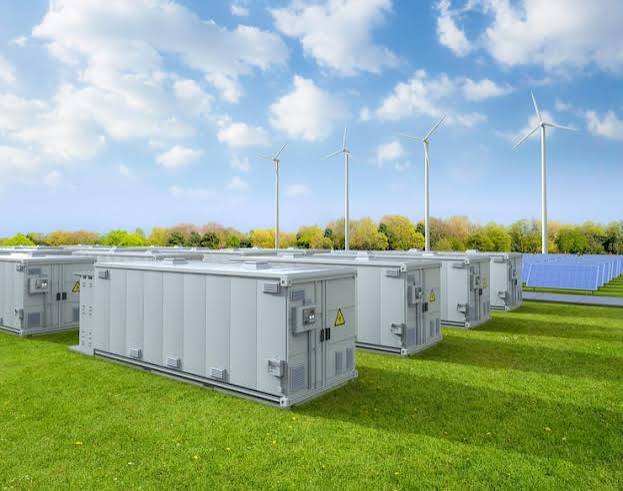
20-foot and 40-foot ISO container format — factory-assembled, pre-commissioned, and equipped with integrated thermal management, fire suppression, monitoring, and inverter. Fast deployment for large-scale commercial and utility applications.

EMS, Thermal & Integration

Energy Management System (EMS)
Intelligent dispatch software — scheduling BESS charge and discharge based on tariff rates, load forecast, solar generation forecast, and state of charge to optimise the financial outcome of every dispatch cycle.
Battery Management System (BMS)
Cell-level voltage, current, and temperature monitoring — state of charge and state of health calculation, cell balancing, overcharge and over-discharge protection, and thermal runaway early detection and response.
Thermal Management — Gulf Rated
Air-conditioned battery rooms, HVAC-cooled enclosures, and container thermal management systems sized for 45–55°C ambient temperatures — ensuring battery temperature stays within the 15–35°C operating window for maximum cycle life.
Fire Detection & Suppression
Lithium battery fire detection (hydrogen and CO early warning sensors) and automatic suppression (inert gas or fine mist) integrated with the BESS enclosure — required for large-scale battery rooms and containerised systems.
BMS & Energy Dashboard Integration
BESS state of charge, charge/discharge power, and cumulative energy throughput integrated with the building BMS energy dashboard — providing unified energy visibility across solar generation, storage, and grid consumption.
SCADA & Remote Monitoring
Remote monitoring portal providing real-time BESS status, performance data, alarm notifications, and historical energy reports — accessible by the client facility team and Virtual Bridge's O&M team simultaneously.
Sectors We Serve

Every facility type. Every storage application.

Virtual Bridge has designed and delivered energy storage solutions across every major sector — each with its own tariff structure, load profile, resilience requirements, and storage economics.

Industrial & Logistics
Large demand charges from production line starts and compressor loads — BESS peak shaving delivers some of the highest financial returns in the industrial sector. EV fleet charging integration without demand spikes.
Government & Civic
Vision 2030 and UAE sustainability targets driving government building storage. Backup power for critical government operations. Solar + BESS for government campus energy management and resilience.
Healthcare
Hospital backup power beyond UPS — BESS providing hours of critical load supply during extended outages. Peak demand shaving on large HVAC and medical equipment loads. Solar + BESS for sustainability targets.
Data Centres
UPS replacement and augmentation with longer-duration BESS backup. Peak demand management for cooling and IT load charges. Frequency support for data centre grid connections with strict power quality requirements.
Hospitality
Hotel solar + BESS reducing energy operating costs. Guest power continuity during outages without noisy diesel generators. Demand charge management on large HVAC and kitchen loads.
Residential
Villa and apartment solar + BESS — evening self-consumption from daytime solar, backup power for air conditioning during outages, and smart home energy management via mobile app.
Seaports & Africa
Hybrid solar + BESS + generator systems for African port and airport facilities — displacing diesel at 50–70% cost saving, improving power reliability, and reducing carbon footprint for infrastructure operations.
Retail & Shopping Malls
Mall demand charge management — large HVAC and lighting loads create significant peak demand charges. BESS with solar reduces demand peaks and provides backup power continuity for retail tenants during grid events.
Selected Projects

Energy storage systems operating. Performance verified.

A selection of Virtual Bridge energy storage projects across the GCC and Africa.

Residential — Lebanon
ADMA 751
Adma, Lebanon · 8,000 sqm · 2024
Solar + LFP BESS · Backup Power · Self-Consumption
Residential — Lebanon
Ô Bakish Villas
Bakish, Lebanon · 2026
Hybrid BESS · Solar Integration · EV Charging
Seaport — DRC
Banana Seaport
Democratic Republic of Congo
Solar + BESS + Diesel Hybrid · Microgrid · Off-Grid
Airport — Angola
Namibe, Catumbela & Luanda Airports
Angola
Airport BESS · Backup Power · Solar Hybrid Microgrid
Commercial — GCC
Commercial Peak Shaving Programme
Saudi Arabia & UAE
Demand Charge Reduction · BESS · Verified Bill Savings
Infrastructure — Africa
Remote Site Hybrid Energy Systems
Multiple African Territories
Diesel Displacement · Solar + BESS · Remote Monitor
Why Virtual Bridge

Sized from financial analysis. Integrated with the building it serves.

Virtual Bridge delivers energy storage as a financially engineered system — sized to the actual tariff and load profile, integrated with the building's solar PV and electrical infrastructure, and monitored to verify the financial performance against the pre-installation model.

Financial Modelling First
Every BESS project begins with a financial model built on actual tariff data and interval load profiles — producing a bankable NPV, IRR, and payback period before any equipment is specified. The model is revisited at the first annual review with actual performance data.
Gulf Thermal Management
LFP chemistry specified as default. Battery room HVAC and container thermal management designed for 45–55°C Gulf ambient. BMS temperature monitoring and thermal runaway protection standard on every system — not optional add-ons.
Integrated MEP Delivery
BESS co-designed with solar PV, electrical LV board, BMS energy dashboard, and HVAC thermal management under one A&S Mechanical and Virtual Bridge group delivery — no interface gaps between storage, generation, and electrical systems.
Verified Performance
Post-commissioning monitoring compares actual demand charge savings, self-consumption ratio, and bill savings against the pre-installation financial model. Annual performance review with updated financial analysis provided to every client under maintenance agreement.
Common Questions

Frequently Asked Questions

Lithium Iron Phosphate (LFP) is recommended for Gulf installations for three primary reasons. First, thermal stability: LFP does not enter thermal runaway until approximately 270°C (versus 150–170°C for NMC chemistry) — making it significantly safer in the high ambient temperature environments typical of Gulf equipment rooms and outdoor enclosures. Second, cycle life: LFP delivers 4,000–6,000 cycles at 80% depth of discharge before reaching 80% of original capacity, compared to 2,000–3,000 cycles for NMC. In an application with one full charge/discharge cycle per day, LFP will last 11–16 years versus 5–8 years for NMC — a significant difference in the total value delivered over the system's lifetime. Third, capacity retention at elevated temperatures: LFP retains capacity better at elevated operating temperatures than NMC, meaning a Gulf BESS using LFP will deliver closer to its nameplate capacity over its lifetime than an equivalent NMC system in the same environment. The energy density advantage of NMC (more kWh per kg) is generally not a significant constraint for commercial and industrial installations where floor area is available, and does not outweigh the thermal, cycle life, and safety advantages of LFP.
Most commercial and industrial electricity tariffs in the GCC include a maximum demand charge — a monthly fee calculated on the highest power demand (measured as a 15- or 30-minute average in kW or kVA) recorded during the billing period. This demand charge can represent 20–40% of the total electricity bill for large commercial and industrial customers. Peak demand shaving works by deploying a BESS to discharge power during the period when the building's demand would otherwise peak — reducing the recorded maximum demand and therefore reducing the demand charge. For example, a hotel with a 500 kW maximum demand that uses a 200 kWh BESS to shave the morning HVAC ramp might reduce its peak demand by 150–200 kW, reducing the monthly demand charge component of its bill by 30–40%. The financial savings depend on the specific demand charge tariff, the magnitude and predictability of the demand peaks, and the BESS capacity deployed. Virtual Bridge quantifies this precisely from the actual tariff and 15-minute interval consumption data in the financial model before system sizing.
A UPS (Uninterruptible Power Supply) and a BESS both provide backup power during grid outages, but they are designed for different applications. A UPS is designed to provide seamless, instantaneous transfer (typically under 10 milliseconds) to protect sensitive equipment from even momentary power interruptions — at high cost per kWh of storage capacity, with relatively short backup duration (typically minutes to 30 minutes). A BESS provides longer-duration backup (hours rather than minutes) at a lower cost per kWh, but with a transfer time that is typically 20–100 milliseconds — acceptable for most loads but not suitable for the most sensitive equipment (operating theatres, certain data centre loads). For most commercial and industrial backup applications, a BESS provides hours of critical load supply during grid outages at a significantly lower cost per hour of backup than a UPS of comparable duration. In hospital and data centre applications, a BESS is often used in conjunction with a UPS — the UPS provides the instantaneous seamless transfer, and the BESS provides the extended duration backup, replacing the diesel generator for planned outage durations or augmenting it for extended outages.
The sizing methodology differs by application. For peak demand shaving, the BESS is sized to discharge sufficient power for a sufficient duration to reduce the recorded peak demand below the target threshold — determined from 15-minute interval consumption data identifying the magnitude and duration of demand peaks, and from the financial optimisation identifying the target demand reduction that maximises the financial return. A larger BESS reduces the peak by more, but with diminishing returns as the second-highest peaks are also reduced. For backup power, the BESS is sized to supply the critical loads (identified from the load schedule or from actual data) for the required backup duration — typically 2, 4, or 8 hours depending on the client's resilience requirement. Where both applications are required simultaneously, the BESS must be sized to meet the larger of the two requirements, or a dispatch strategy is developed that preserves a minimum state of charge for backup while using available capacity for peak shaving during normal operation.
Lithium-ion battery fire protection is a critical design element for any BESS installation above a certain capacity. The fire risk from lithium batteries is thermal runaway — a chain reaction in which an overheating cell causes adjacent cells to overheat, potentially leading to fire and toxic gas release. For small residential and light commercial BESS (under approximately 20 kWh), the battery management system's thermal monitoring and protection circuits are typically the primary mitigation, with the battery located in an area with adequate ventilation. For larger commercial and industrial BESS (above approximately 50 kWh), Virtual Bridge specifies: early warning gas detection (hydrogen and CO sensors that detect thermal runaway before flame), automatic fire suppression within the battery enclosure (inert gas or water mist), active battery management system monitoring with automatic disconnection on thermal runaway detection, fire-rated battery room construction (2-hour fire rating minimum), mechanical ventilation to prevent gas accumulation, and fire alarm integration with the building fire alarm system. Containerised BESS systems typically arrive with integrated fire detection and suppression as factory-installed equipment. All large BESS fire protection designs are reviewed against the applicable GCC Civil Defence requirements and IEC 62933 and NFPA 855 standards for stationary battery energy storage.
Yes. Virtual Bridge provides planned preventive maintenance (PPM) contracts for installed BESS systems — including quarterly remote monitoring review (performance data analysis, alarm history review, state of health trend), biannual site visit (electrical connection inspection and torque check, BMS data download and analysis, inverter health check, cooling system inspection), and annual comprehensive service (battery capacity test comparing actual capacity against nameplate and against the previous year's measurement, state of health report, financial performance review comparing actual bill savings against the pre-installation financial model, and recommendations for any dispatch strategy adjustments to maximise ongoing financial return). The annual performance review is particularly important — a BESS whose EMS dispatch strategy was optimised at commissioning may need reoptimisation as tariff structures change, occupancy patterns evolve, or additional loads are connected to the building. Virtual Bridge provides this reoptimisation as part of the annual service.
Ready to discuss your energy storage scope?

Whether you need a financial model for peak demand shaving, a residential solar + BESS system, a commercial BESS for backup power, or a multi-MWh containerised system — the Virtual Bridge and A&S Mechanical energy storage team is ready to respond within one business day.

Related Services

Systems Energy Storage Works With

Solar PV Systems
Solar generation charged to BESS for self-consumption maximisation — co-designed and co-delivered under A&S Mechanical's integrated renewable energy scope.
View service
Electrical Contracting
LV board modifications, generation metering, grid protection relay, and BESS electrical connection — coordinated under VB's integrated electrical and renewable delivery.
View service
Building Management Systems
BESS state of charge and performance data integrated into the BMS energy dashboard — unified energy visibility across solar, storage, and grid consumption.
View service
HVAC Systems
HVAC is the dominant building energy load in the GCC — BESS peak shaving targeted at HVAC demand peaks delivers some of the highest financial returns available in commercial storage applications.
View service